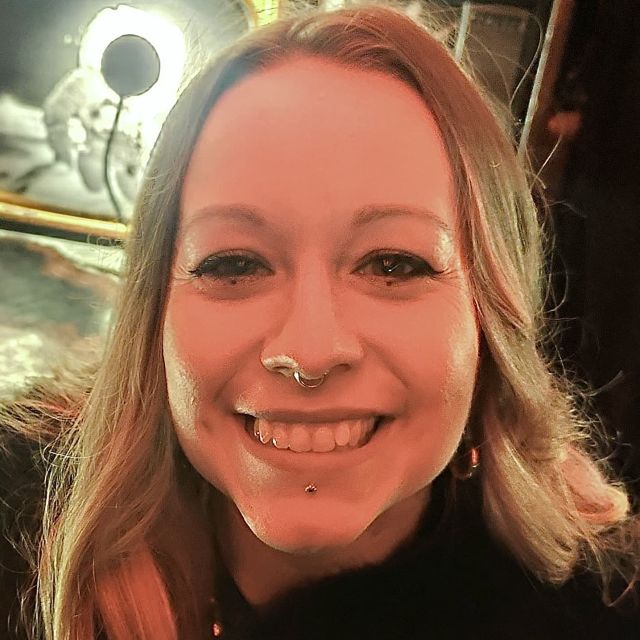
Please tell us your story! How did you get to where you are today?
I had a totally different life 10 years ago. I studied administration and HR and started my career in finance in Luxembourg where I stayed for about 10 years. I then moved to the West of France and started following my husband (who is a light designer working with many international bands), helping on merch and tour management duties when I could. At the same time, I was questioning myself about what I really wanted to do as a living. The answer was crystal clear, I wanted to continue working on the administrative side of things but in a field that made sense to me which was heavy music. Then, I was lucky enough to meet the right people at the right time. I had the opportunity to join the artist department at Hellfest for a few months as a replacement for a maternity leave and at the same period, got a tour management job for a French metalcore band (that unfortunately no longer exists, Betraying The Martyrs). Finally, what was supposed to be a 4-month contract at Hellfest turned into a full-time job. I took over the responsibility of the artist department and started booking the Altar and Temple stages (respectively dedicated to death and black/pagan metal) some months after joining.
“Life is made of opportunities, but you have to create these opportunities, especially in this very competitive industry.”
Tell us about your current role and professional life – what does your day-to-day entail?
I’m currently a talent buyer for 4 stages at Hellfest Altar / Temple / Crypt / Forge which are the 4 most extreme stages of the festival. I am also leading the artist department, taking care of artist administration and production, dealing with providers, backstage teams and volunteers, making sure everyone is in the right place and everything runs smoothly.
I do not really have a “typical day at work” as my tasks are defined by the period of the year. From September to November, I’m focused on the booking and the preparation of documents for the upcoming edition. Once the line-up is complete, I start working on artist contracts and paperwork. Then, I start working on the advance with our production team and backstage team leaders.
“Working in the music industry is not about partying all the time, it’s a very demanding environment requiring soft skills and know-how.”
How did you get your start in the industry? Any advice for people wanting to work in your field?
I finally started working in the industry meeting the right people at the right time, because I showed up and volunteered to help at gigs whenever I could. Life is made of opportunities, but you have to create these opportunities, especially in this very competitive industry. Keep your goal in mind, work hard, show people they can rely on you, and it will pay off. Be aware that working in the music industry is not about partying all the time, it’s a very demanding environment requiring soft skills and know-how. Most of the time what you see on stage is totally different from a “behind the stage” point of view. It’s the result of passionate people working hard together, often sleeping for a very few hours, dealing with unexpected events and finding solutions so the show can go on.
What does “heavy music” mean to you today, given how much the genre has splintered?
That’s indeed a good question! Heavy music is not only about music itself, but also about the process and the way the music is created. It’s about experimenting, pushing the limits and trying new things no matter what’s expected or trendy. To me, the most important thing with heavy music is that it creates emotions in me, and depending on the style it creates different kinds of emotions. That’s also what makes the richness and quality of heavy music. New bands, new styles, new sub-genres are popping up all the time, and you can never get bored!
“The most important thing with heavy music is that it creates emotions in me, and depending on the style it creates different kinds of emotions.”
Have you had to overcome any challenges or adversity in your career, and if so, how did you approach them?
It’s never easy to be a woman in an environment mainly led by men. Even if mentalities are changing and most of the time everything is fine, patterns where “you should be the assistant, the singer’s girlfriend or the merch girl” are still alive.
In those cases, I just remember that I don’t have to prove myself and try not to let myself be overwhelmed by other’s attitude. I don’t try to justify myself and just keep doing my job the way I think it should be done. Usually when people see you know what you’re doing, and you deliver you kind of gain their respect.
“I just remember that I don’t have to prove myself and try not to let myself be overwhelmed by other’s attitude.”
What has been the best gig that you’ve ever seen?
I had the chance to witness a special show of Septicflesh with the Athens State Orchestra at a very special place: the Odeon of Herodes Atticus in Athens. I felt very honored to be part of this special event and the communion between the musician and the audience made it a magical moment that I will remember forever.
Who are the Australian heavy acts on your radar, that should be on ours?
Here are 3 bands that I listen to on “repeat” for several years and that I still keep the same excitement listening to:
Ne Obliviscaris : introspective, progressive yet very melodic and accessible even for people who are not into heavy music.
Austere : depressive black metal. Very introspective and strong in terms of emotions.
Woods of Desolation : post-black metal, melodic and emotional.
What is the current musical landscape like where you live?
I think we are quite lucky in France especially with the specific employment status of “intermittent du spectacle” (that could be translated as temp worker of the show business industry), many bands and crew are able to live out of their music and passion.
The musical landscape is therefore dynamic and quite rich in every style. Nevertheless, due to the French and worldwide political context, we can notice things are changing. Costs linked to touring have exploded, subsidies granted by the government are drastically cut-off, small venues and festivals are now jeopardized and it of course has financial and human impacts on the whole industry.
“Heavy music is not only about music itself, but also about the process and the way the music is created. It’s about experimenting, pushing the limits and trying new things no matter what’s expected or trendy.”
Hellfest books everything from Metallica-scale headliners to emerging heavy acts across six stages – what’s your process for finding the next big name before anyone else has heard of them?
At Hellfest, we are a team of 3 talent buyers, with specific styles of focus. We listen to music all the time, keep us informed about newcomers thanks to specialized press or web/fanzines, go to concerts and festivals whenever possible and also try to listen to all the bands that apply to play at the festival. That’s the best way to discover hidden gems. Sometimes it’s also just betting that the band we have a crush on will please the audience.
What is your go-to Karaoke song?
I’m a late 80’s child who happened to be a teenager in the 00’s so of course if you play the Spice Girls or the Backstreet Boys I’m in !