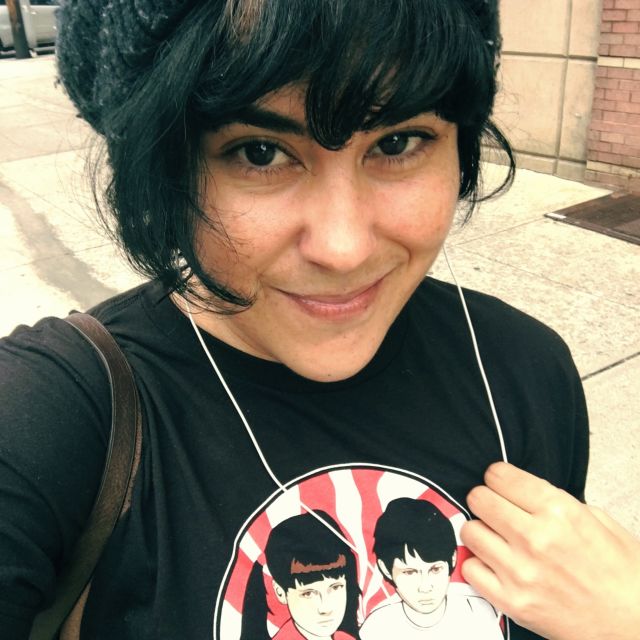
Please tell us your story! How did you get to where you are today?
I started out writing about local music in Los Angeles around 2011 or so. We had a really happening music scene and I thought it deserved a publication that was locally focused rather than national, so I started it! This led me to also booking and promoting underground punk/garage shows in L.A., which was a great way to get integrated with the wider world of underground music and touring bands. Eventually it became difficult working a day job while also doing music at night (also a job), but I was fortunate enough to be hired by Bandcamp as their social media producer in 2016 for the then-brand new Bandcamp Daily. In 2021, I was promoted to senior editor.
Tell us about your current role and professional life, what does your day-to-day entail?
As the senior editor at Bandcamp Daily, I’m second-in-command to our editorial director, J. Edward Keyes. In addition to working with writers, fielding pitches, and editing pieces for the Daily, I also spend a lot of time coming up with ideas for presenting music and musical trends that are a bit different than the usual listicle or “guide to” formats often seen on other music sites. (Notable recent examples would be an essay on the ascendance of power pop, another on the influence of Spacemen 3, and a column focused on jam bands and jam-adjacent music.) In 2025, I launched Bandcamp Notes, a newsletter hosted on Substack, focused on simple music discovery, which I curate and edit. I was inspired by 90s zines and alt-weeklies, so in addition to the weekly “Cool Band Alert”—one great new group in your inbox per week—we also have a monthly music advice column and Bandcamp listening party listings in every newsletter. I’m also the host of The Indie Show, a Bandcamp Radio show focused on indie music (which I define as an ethos rather than a specific “sound,” so I play loads of diverse stuff, ranging from 60s surf to modern avant-garde rock to 80s alt-country). My day-to-day tasks can vary but basically I am always thinking about music and musicians and how best to get their art out into the world in whatever way I can.
“There really is zero substitute for hands-on experience in music. Not only is it loads of fun, the connections/friends you make are ones that you can carry with you as you move up the professional ladder.”
How did you get your start in the industry? Any advice for people wanting to work in your field?
Do it yourself. Participate in your local music scene. Make friends with a band. Go on tour. Write a zine. Book a show. Start a tape label. There really is zero substitute for hands-on experience in music. Not only is it loads of fun, the connections/friends you make are ones that you can carry with you as you move up the professional ladder, who will keep you both honest and tuned into new stuff before it hits the mainstream (or any stream). Bonus: It never feels like “networking.”
Do it yourself. Participate in your local music scene. Make friends with a band. Go on tour. Write a zine. Book a show. Start a tape label.”
What advice would you give an unsigned artist trying to get editorial attention?
Make friends with a music journalist. If you have a new release you’d like covered, make a list of journalists who write about your style of music and reach out personally. A firehose approach will hit all bases, but might not connect with any of them. Include 3-4 “Related If You Like” artists in your pitch so people have a rough idea of what to expect (don’t make them *too* obscure). Also remember that there are many different ways to get covered. You might not get your album reviewed or an interview feature, but you could get mentioned in a social media post or added to a playlist or something similar. These are all wins. Oh, and always send links to .WAV files—not everyone uses Spotify!
What have been your career highlights to date?
Getting John Dwyer to agree to be the inaugural guest on The Indie Show, going on tour with Dummy and writing a two-part tour diary about it, going to Cork to write about the Irish DIY scene and by chance ending up at an amazing experimental music DIY festival, launching and running Bandcamp Notes…too many to count!
“I’m probably something of a publicist’s nightmare in that if I see an artist has already been extensively covered in larger publications, I’m less likely to want to cover them.”
How does Bandcamp’s direct-to-fan model shape what “discovery” means for you as an editor?
It does preclude me from covering any music that isn’t on Bandcamp, which can be good and bad. Good in that I don’t want to cover Taylor Swift and cannot, bad in that I do want to write about (for example) Pentangle or the White Stripes but cannot. In a broader sense, I would say that Bandcamp’s model pushes me to think holistically about music coverage. We are literally in the record selling business, so what would be the best way to get people interested in records they’re not already looking for? For me, that means pushing writers to take broader approaches to coverage, such as making a strong argument as to why a certain band is important with their records as supporting evidence rather than writing a list-style a guide to their albums, as well as trying to surface scenes and movements that aren’t going to get a shot anywhere else. I’m probably something of a publicist’s nightmare in that if I see an artist has already been extensively covered in larger publications, I’m less likely to want to cover them on Bandcamp Daily.
What’s a piece you wrote that you’re proudest of, and why did it stick with you?
I suppose it would have to be “How To Make a Watch,” the two part tour diary I wrote about going with Dummy on their first full US tour. I was able to write freely about my belief in the sanctity of music and DIY, the persistence of underground culture despite great odds (the article was written in 2021, just after the pandemic, and yes—we all got COVID on tour), and how beautiful it is to see people work hard at their art and succeed outside of the “indie” industrial hype machine. Plus it made a lot of people mad, which I suppose is one of the points of real journalism rather than celebrity journalism.
“How beautiful it is to see people work hard at their art and succeed outside of the ‘indie’ industrial hype machine.”
How do you manage work/life balance?
Work is play to me, so I actually have to make myself stop working! My best tip is to try not to work at home too much. I go to my local library to work, so when I’m home I can focus on my own creative projects or just lounging around. Rest is very important, too.
“Work is play to me, so I actually have to make myself stop working!”
What is your go-to Karaoke song?
I actually don’t enjoy Karaoke so I don’t have one—weird, I know!