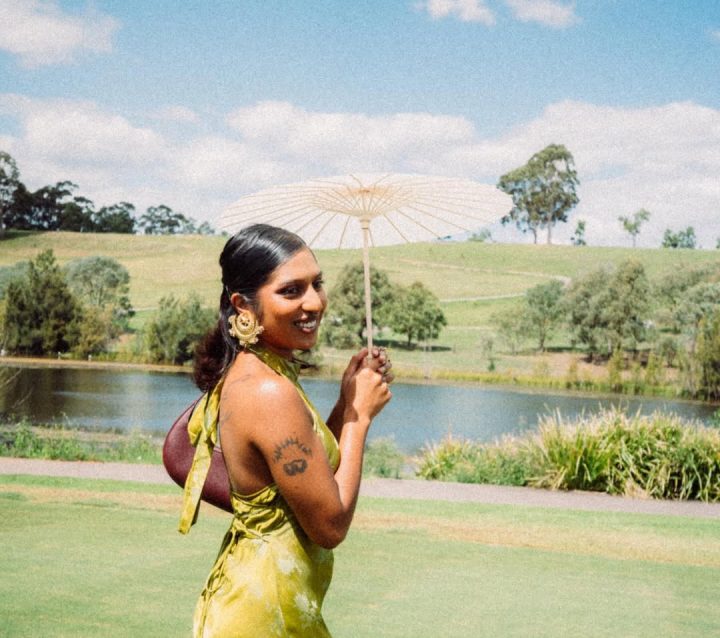
Please tell us your story! How did you get to where you are today?
Honestly, it’s been a bit of a winding road which I think is true for most people in this industry. I didn’t follow a straight path into music professionally. It started with a genuine love for the culture, for electronic music and the communities that form around it. I was working in media marketing and hitting a wall, and my real release was being on dancefloors, supporting the grassroots dance community. That connection to the scene started shaping into something more active. I found myself bouncing ideas with friends who were DJs and promoters, acting as a kind of informal, ghost consultant before I even had a name for what I was doing.
My community kept telling me to get on the airwaves, so I did, pulling graveyard shifts at FBI Radio, which I loved. From there I landed my first label role, quickly realised label-side wasn’t where my heart was, and then received a referral that changed everything: three years as City Manager for Sydney at Resident Advisor. That chapter gave me a real depth of understanding of where I actually wanted to put my energy, platforming the ANZ grassroots scenes and the people who power them.
That clarity has shaped everything since. I now hold four roles simultaneously: Community Engagement Manager at EMC, Head of Partnerships and Events at Mixmag ANZ, and artist manager and booking agent at Kast Agency in Naarm, where I get to support POC artists in the dance music community. Each role informs the others in ways I genuinely didn’t anticipate, and I feel really fortunate to be doing work that started as pure love for the culture.
Tell us about your current role and professional life, what does your day-to-day entail?
No two days look the same, which I love and occasionally find overwhelming. Across my roles, Community Engagement Manager at EMC, head of Partnerships and Events at Mixmag ANZ, and artist manager and booking agent at Kast Agency in Naarm. I could be doing anything from drafting partnership proposals and coordinating event logistics, to negotiating show deals for artists on my roster, to thinking about how to build more meaningful connections between communities and music spaces. There’s a lot of email. A lot of calendar Tetris. But there’s also moments of real creative collaboration that make it all worthwhile.
“Find the spaces that are run by people who genuinely love the culture, not just the clout, those spaces will teach you everything.“
What issues/potential issues do you think the current Australian music industry faces? Specifically in your realm of work.
A few things feel urgent to me right now. The cost of touring and producing events in Australia is genuinely prohibitive venues are closing, hire costs are rising, and it’s getting harder for emerging artists to find spaces to develop their craft in front of a live audience. I also think there’s still a lot of work to do around diversity and inclusion, particularly in electronic music, making sure the communities we talk about building are actually accessible to everyone, not just a narrow demographic. And from a media perspective, independent music journalism is under real pressure. Long-form coverage of local artists is shrinking, and that has a flow-on effect on how artists build their profile and connect with audiences.
If you could change one thing in the music industry right now, what would it be?
If I could change one thing, it would be the extraction that happens to grassroots and underground scenes without anything being given back. There’s a pattern that repeats itself constantly, a sound, a community, a culture gets built from the ground up by people who are deeply invested in it, often with very little resources, and then once it gains traction, it gets absorbed by larger commercial interests who benefit from the cultural currency without ever having done the work. The underground becomes a trend, the grassroots becomes a brand aesthetic, and the people who actually built it are left behind.
I’d want to see a genuine shift in how the industry relates to those scenes, not just as a pipeline for the next marketable thing, but as something worth protecting and investing in on its own terms. That means money flowing back down, platforms amplifying without appropriating, and decision-makers actually listening to the communities they’re profiting from. The grassroots is where the culture lives. If we keep extracting from it without replenishing it, we all lose.
“Once you see how much heart goes into building these scenes from the ground up, you want to be part of protecting and growing them.”
How did you get your start in the industry? Any advice for people wanting to work in your field?
I got my start the way a lot of people in this industry do through volunteer and community-led spaces. FBI Radio was a huge part of that for me.
Honestly though, I never thought I’d end up as a full-time music girly. It wasn’t a calculated decision, it was something that crept up on me organically. It started on the dancefloor. It started with my community. I did a lot of trial and error before I found my footing. There was no lightbulb moment, just a gradual realisation that I was already doing the work because I loved it. It began with showing up to support my friends at their gigs, helping with curation for their parties, being outside and present in the spaces where things were actually happening, and witnessing firsthand the incredible work the grassroots community was doing nationally.
For me, coming from Western Sydney and making my way into the city, finding those communities was everything. When you don’t necessarily have a built-in network, or you’re coming from somewhere that feels a bit removed from where the industry lives, stumbling into a room full of people who care about the same things you do is genuinely life changing. You realise you’re not alone in it, and that realisation gives you permission to take up space.
My advice to anyone wanting to find their way in is to look for those spaces first, community radio stations, volunteer roles, grassroots collectives because they are the most accessible entry point. More often than not they’re where the most passionate, like-minded people are. Find your fBI radio. Show up consistently, and let the relationships do the rest. That exposure made it impossible to look away, and once you see how much heart goes into building these scenes from the ground up, you want to be part of protecting and growing them. It really does take a village. I wouldn’t be where I am without the people who brought me into the fold and trusted me to show up for them.
Why did you want to get into the music industry?
Because music, particularly the kind of communal, dancefloor, live-experience music I’m drawn to, has this rare ability to make people feel less alone. And for me, as a POC woman, the dancefloor was never just a place to dance. It was a place to exist fully, to feel seen, to be part of something that didn’t ask you to shrink yourself. Music is inherently resistance. It always has been. The genres and subcultures that shaped me, electronic music, dance music, the underground are rooted in communities that used sound and space as a form of survival and expression, often in the face of being marginalised or ignored by the mainstream.
Dancefloors moved me in the most literal and profound sense. They showed me what it felt like to be in a room where everyone was equal in the darkness, united by a shared frequency. That feeling is hard to describe to someone who hasn’t experienced it, but once you have, you understand why people dedicate their lives to protecting it.
I always knew I didn’t want to be a DJ but I knew early on that I had skills to offer behind the scenes, and that those skills were just as necessary to making the magic happen. That’s actually how I got the nickname DJ Mommy, always in the thick of it, holding everything together, making sure everyone was okay, just never behind the decks. I wanted to help create the conditions for those moments to happen, and to support the artists and communities who make them possible because that work is not just cultural, it’s deeply human.
What would you tell your younger self if you could tell them anything?
I’d tell her that coming from Western Sydney is not a disadvantage, it’s a perspective, and perspectives are valuable in an industry that can become very insular very quickly. I’d tell her that the city can feel intimidating when you first come into it, like everyone already knows each other and you missed some memo about how to belong. But those feelings are temporary, and the people worth knowing will make you feel welcome. Find your community early. Find the spaces that are run by people who genuinely love the culture, not just the clout, those spaces will teach you everything. And show up for your people the way you’d want them to show up for you, because in this industry, that’s the currency that actually matters.
What is your big picture career goal?
My big picture goal isn’t about building something I own, it’s about building something my community can live and grow in long after I’m involved. A sustainable creative environment where artists and music workers in Australia have the conditions they actually need to thrive and not just survive. Whether that takes the shape of a collective, a platform, a resource, or something that doesn’t have a name yet, I’m less attached to the form it takes and more focused on what it produces: genuine opportunity, longevity, and care for the people doing the work at the grassroots level. I’m still figuring out exactly what that looks like, but the direction is clear. It was never about me, it’s always been about the community.
“It was never about me, it’s always been about the community.”
What have been your career highlights to date?
There are a few moments that genuinely stop me in my tracks when I reflect on them. Producing the Mixmag ANZ Lab in Bali with Theo Parrish was one of those pinch-me experiences. Theo is a legend in the truest sense of the word, and getting to create that space and bring that moment to life felt like everything I’d been working toward crystallising in real time.
Working on international programming and artist retreats in Thailand with EMC has been another kind of highlight entirely, less about the spectacle and more about the depth of it, watching artists have the time and space to connect, create and be genuinely cared for. And then hosting and facilitating conversations between Asian and Australian community radio figures at ADE in Amsterdam was something I’m incredibly proud of, bringing those two worlds into dialogue on an international stage, and proving that the stories and voices coming out of our region deserve to be part of that global conversation. Each of these moments reminded me why I do this work and how far it can reach when you stay true to what you believe in.
What is the current musical landscape like where you live?
The current landscape in Eora/Sydney feels really exciting and genuinely different to what it was even a few years ago. What’s been beautiful to witness is the rise of third spaces, venues and environments that aren’t just clubs, but intentional spaces built for deep listening, that can hold both live music and DJs in the same breath. There’s a real thoughtfulness to how people are curating experiences now, and audiences are responding to that.
But what excites me most is what’s happening nationally, the rise of diaspora collectives across the country. Collectives like Chuleo Club, Bypass, Club Haus, Dutty Worldwide, Heaven, h34ven0n34rth and Konti Lang are doing some of the most vital and interesting work in Australian music right now, each with their own distinct cultural identity and community behind them. Across Australia we’re seeing people use music as a way to celebrate, preserve and platform their cultural identities and it’s producing a genuine shift in who gets to take up space in this industry and on whose terms. That’s something worth paying very close attention to.
Any tips for a quick ‘pick me up’ if you’re having a bad day?
Honestly, music is always the first thing I reach for. I have a collection of mixes saved specifically for rainy days, the ones that have never failed me, that feel like being wrapped in something familiar and warm. There’s something about surrendering to a good mix that resets everything. And when I really need to decompress, I turn to neo soul and jazz, there’s something about those genres specifically that slows everything down and reminds you to breathe. Beyond that, stepping away from the screen and being around the people I love helps more than I can explain. Whether that’s hanging out with friends or my partner cooking an incredible meal at home or the two of us finding a little hole in the wall spot to eat at. My partner and I are both huge food people so good food and good company is genuinely restorative. In an industry that runs on emails and notifications and being constantly switched on, sometimes the most radical thing you can do is just put your phone down, press play on something that moves you, and let the simple things bring you back to yourself.